Navigating the costs of launching a startup

TL;DR
- Identify startup costs early so you can budget, forecast cash flow, and manage runway before you launch.
- Categorize costs in three ways: one-time vs. ongoing, fixed vs. variable, and essential
- vs. optional. Keep ongoing costs manageable and add optional expenses only as profitability grows.
- Build a cash buffer before launch to cover variable costs that fluctuate with business activity (inventory, payroll, marketing).
- Startup and organizational costs (like incorporation, office setup, and equipment) may each be tax-deductible up to $5,000. That deduction is reduced when total costs exceed $50,000.
- Estimate your total costs by listing every expected expense (website, remote tools, inventory) and using resources like the SBA worksheet to support early financial planning.
Before you take the plunge into launching your startup, there's a lot to consider — especially when it comes to the cost. Think of these expenses as the groundwork for your journey, the stepping stones that pave the way from idea to reality. Whether it's securing your domain name, setting up shop online, or ensuring your team gets paid on time, each cost plays a role in building a strong foundation for your company.
In this guide, we'll walk you through the essential costs to consider, helping you navigate the financial terrain of starting your business with confidence.
Why should you explore startup costs before starting your company?
Understanding startup costs before you dive into launching your company isn’t just a smart move—it’s essential for your business’s survival and growth. Imagine trying to build a house without knowing how much lumber or concrete you’ll need. The same principle applies to your startup. Knowing your costs up front allows you to budget effectively, avoid unexpected financial pitfalls, and make informed decisions that keep your business on track.
When you’re clear on your startup costs, you can set realistic milestones and ensure you have the necessary resources to reach them. It’s the difference between being prepared and scrambling to make ends meet. Plus, a solid grasp of these expenses gives you the power to manage your cash flow, ensuring you have enough runway to sustain operations until your revenue starts to take off.
Understanding the different costs associated with launching a startup
Startup costs can be incurred before you’ve launched your business or might be tied to the actual launch. There might also be one-off costs that you’ll pay a single time at the beginning, or they might be costs that will pop back up on a recurring basis. Identifying the different categories of startup costs — their importance, their cadence, their flexibility — will give you a clear view of your startup expenses. This in turn will allow you to forecast your cash flow and get a sense of the money expected to flow in and out of your business in its first few months.
Here are a few of the core categories of expenses and how to think about each as you run through the list of your own startup costs:
One-time versus ongoing costs
When it comes to launching your startup, not all costs are created equal. Some are one-time expenses, while others will stick around as ongoing costs. Understanding the difference can make a big impact on how you budget and plan.
For instance, if you’re running an ecommerce company with a small team, ongoing costs might include payroll, payment processing fees, and regular vendor payments — expenses that you can predict and plan for each month. On the other hand, one-time costs could be hiring a graphic designer to create your website or purchasing a web theme. These are investments you make once at the start and then don’t have to worry about again (at least for the foreseeable future).
Ongoing costs are the steady beats of your business budget, providing a rhythm that’s easier to anticipate and manage. One-time costs, however, often pop up when you’re first launching and can sometimes catch you off guard, like unexpected repairs or initial setup fees. That’s why it’s crucial to research these expenses ahead of time and ensure you have the funds to cover them, whether it’s for incorporation fees, buying essential equipment, or securing licenses.
As a general rule, aim to keep your ongoing costs manageable and predictable, and be prepared for those one-time expenses, especially in the early stages. Setting up automated payments for your recurring costs can help you stay on top of your budget.
Fixed versus variable costs
In the case of ongoing or recurring costs, you should also consider whether those costs are fixed or variable. Fixed costs are consistent, staying the same month after month, while variable costs can change depending on factors like the season or your business’s activity level.
Fixed costs are the steady, predictable expenses that form the backbone of your budget — think rent on a retail space with a long-term lease. These costs are easier to plan for because you know exactly what you’ll owe each month. On the other hand, variable costs, such as utilities, shipping fees, and supplies, can fluctuate, sometimes catching you off guard.
Since variable costs can swing with the ups and downs of your business, it’s smart to plan for a cash buffer before getting your startup off the ground. Monitoring these expenses closely can help you spot patterns and anticipate changes. For a SaaS company, variable costs might include things like cloud hosting fees, which can increase as your user base grows, or customer support costs, which might rise during product launches or updates. By understanding and planning for both fixed and variable costs, you’ll be better equipped to navigate the financial ebbs and flows of your business.
Essential versus optional costs
Another important variable is the level of importance associated with different startup costs.
Essential costs are must-have expenses needed to operate your company. These vary widely depending on your business model, industry, etc. For example, if you run a brick-and-mortar business with no employees, your essential costs might include rent, utilities, insurance, and inventory. For an ecommerce company with three employees, essential costs might include payroll, website costs, domain and hosting, and payment processing fees.
Optional costs are nice to have but are not necessary. They can be an educational resource or a piece of equipment that might enhance your way of doing business, but you can survive without them. For example, an ecommerce company may choose to pay for social media publishing tools like Buffer or Sprout Social as part of their initial startup plan. While these costs might be deemed valuable — social promotion can be a great way to build buzz and awareness in your startup’s early days — they aren’t mission critical to the day-to-day business operations of running your company.
When you’re just starting your business, it’s encouraged to stick to your core expenses and to only add optional expenses as you grow and become more profitable.
Common startup expenses
Although startup costs vary widely depending on your business and the industry it operates in, there are some common expenses worth keeping in mind. Below, we've listed some of the most common startup costs to keep in mind as you budget and finally prepare to launch your business:
Incorporation
There are several ways to structure your business, including as a limited liability company (LLC) or a sole proprietorship, which are common options in a company’s earlier stages. Incorporating comes with a host of benefits, including ensuring the protection of your personal assets and the ability to open a business bank account. The costs of incorporation can include fees for filing articles of incorporation with the Secretary of State, franchise taxes, and getting an attorney.
Typical ranges:
- LLC formation filing fees range from $40 (Kentucky) to $500 (Massachusetts), with many states in the $50–$200 range.
- If you use a registered agent service (required in many states), expect $100–$300/year.
- Legal fees for drafting an operating agreement typically run $500–$2,000 for a standard setup.
- Delaware is a popular choice for incorporation for startups planning to raise venture capital, with a $109 incorporation fee and $300 annual franchise tax for standard LLCs. (See Delaware Corporate Fee Schedule and Franchise Tax for current rates)
Office space
The cost of office space varies widely depending on factors like your location, whether you’re looking to rent or buy, and how much space you'll need. Sometimes, co-working spaces can offer cheaper, more flexible options than traditional rental units. Virtual offices are also popular for small companies. For example, if you’re an ecommerce company with three employees, you might not need or be able to afford a physical space just yet. But in that case, you’ll want to make sure you factor any necessary subscriptions (Zoom, Slack, etc.) to support your company’s remote model.
Typical ranges:
- Coworking memberships start at $200–$500/month per desk.
- A virtual office (business address and mail handling) typically costs $50–$150/month.
- Dedicated office space for a small team in a mid-tier city averages $25–$50/sq ft/year, while major metros like San Francisco or New York can exceed $60–$80/sq ft/year.
Payroll
Payroll is often cited among the most expensive monthly startup costs. This includes the paychecks you send to employees, as well as processing costs from using payroll platforms like Gusto.
Typical ranges:
- Gusto’s base plan starts at $49/month plus $6/person/month
- Rippling requires you to reach out for a quote.
- Beyond platform fees, budget for employer payroll taxes (7.65% of wages for Social Security and Medicare) plus state unemployment insurance, which varies by state.
Website
Your website is often the first place potential customers interact with your brand, so making a strong first impression is key. Costs for setting up your website can include purchasing a domain name, web hosting, and investing in a website template or designer. Whether you’re building from scratch, using a platform like WordPress or Squarespace, or hiring a professional to create something custom, these expenses can vary. For an e-commerce site, you might need features like a shopping cart and payment gateway, while a SaaS company might prioritize a clean user interface and seamless customer onboarding. No matter your business type, you’ll need to invest in a website that is functional, reflects your brand’s identity, and serves your customers’ needs.
Typical ranges:
- Domain names can be as cheap as $10-$20/year, but can go much higher for domain extensions like .ai or .io
- Squarespace plans run $19-$119/month
- WordPress plans run $4-$45/month, with an enterprise option
- Shopify (for ecommerce) starts at $29/month
- A custom-designed website from a freelance developer typically costs $3,000–$10,000+, depending on complexity.
Marketing
When launching your startup, generating buzz and getting your name out there is crucial. The initial marketing costs are all about building brand awareness and driving those first waves of customer interest. These costs can include creating a compelling brand identity, developing launch campaigns, and investing in early-stage advertising efforts. You might spend on social media ads to build a following, search engine marketing to appear in relevant searches, or even direct mail for targeted outreach. Additionally, you may invest in a professionally designed logo, marketing materials, and a launch event to make a splash. While ongoing marketing will focus on sustained growth, your initial marketing budget is dedicated to making sure your startup starts with a bang, grabbing attention, and setting the stage for long-term success.
Typical ranges:
- A logo from a freelance designer could cost $50–$2,500, depending on if you just need a logo or if you’re doing additional branding work.
- Early-stage paid ad budgets for startups commonly range from $500–$3,000/month across platforms like Google Ads and Meta.
- Email marketing platforms (Mailchimp, Kit) start free for small lists, scaling to $20–$100/month as your list grows.
Inventory
If your startup sells physical goods, inventory costs are important to consider. Quantity, size, storage time, and storage location of your goods are all factors that impact inventory costs. (Some companies opt out of inventory altogether, choosing to create products after an order has been placed or by dropshipping.)
Typical ranges:
- Initial inventory orders vary widely by product, but many ecommerce startups budget $2,000–$10,000 for a first production run.
- Third-party logistics (3PL) storage fees typically run $20-$40/pallet/month, plus per-order pick-and-pack fees of $2-$5/order.
Equipment
Equipment is a critical investment for startups, directly impacting your team’s productivity and growth. Whether you need laptops and servers for a SaaS company or prototyping tools for a hardware startup, the right equipment will support your business operations and scalability. Focus on acquiring technology that meets your current needs and can scale as your business grows.
Typical ranges:
- A MacBook or comparable laptop runs $1,000-$2,500 per employee.
- Monitors, peripherals, and accessories add $200-$500 per setup.
- For SaaS companies, cloud infrastructure (AWS, Google Cloud) starts with free tiers and scales to $100-$500+/month as usage grows.
State fees and obligations by state
Filing fees and ongoing obligations vary significantly by state. The table below covers five popular states for startup formation.
Check the official state sites for current fee schedules, as these can change annually.
State & LLC filing fee | Registered agent | Franchise tax / annual fee | Annual report |
|---|---|---|---|
Delaware ($110) | Required | $300/yr flat tax for standard LLCs | Due June 1 annually ($50 fee if applicable) |
California ($70) | Required | $800/yr franchise tax | Statement of Information due within 90 days, then biennially ($20) |
Texas ($300) | Required | Franchise tax applies if revenue exceeds $2.65M (2026 threshold) | No annual fee. Annual franchise tax report due May 15 |
New York ($200) | Required | Filing fee based on NY-source business income or business capital ($25 minimum) | Biennial statement ($9) |
Florida ($125) | Required | No franchise tax for LLCs | Annual report due May 1 ($138.75 fee) |
Note: Registered agents are $100-$300 per year.
How to budget your startup costs
Below are a few examples showing what a realistic pre-launch and first 3 months of expenses might look like.
Scenario 1: SaaS startup (2 founders, no employees yet)
Expense | Month 0 | Monthly ongoing | Type |
|---|---|---|---|
DE LLC formation + registered agent | $490 | — | One-time, essential |
Domain + Squarespace | $39 | $19 | Ongoing, essential |
Cloud hosting (AWS/GCP free tier + overages) | $0 | $50–$200 | Ongoing, variable |
2x laptops | $3,000 | — | One-time, essential |
Software (Slack, GitHub, Figma) | $0 | $50–$150 | Ongoing, essential |
Paid ads (Google, LinkedIn) | $500 | $500–$1,500 | Ongoing, optional |
Legal (operating agreement) | $1,000 | — | One-time, essential |
Accounting software (QBO) | $0 | $38 | Ongoing, essential |
Totals | ~$5,029 | ~$657-$1,907 / mo |
Scenario 2: Ecommerce startup (1 founder + 2 part-time employees)
Expense | Month 0 | Monthly ongoing | Type |
|---|---|---|---|
LLC formation (FL) + registered agent | $425 | – | One-time, essential |
Shopify plan | $29 | $29 | Ongoing, essential |
Initial inventory (first production run) | $5,000 | – | One-time, essential |
3PL setup + storage | $200 | $150–$400 | Ongoing, variable |
Payment processing (Stripe/Shopify Payments) | – | 2.9% + $0.30/transaction | Ongoing, variable |
Payroll (Gusto, 2 PT employees) | $0 | $61 | Ongoing, essential |
Marketing (Meta ads, email) | $1,000 | $1,000–$2,000 | Ongoing, optional |
Business insurance (general liability) | $0 | $50–$100 | Ongoing, essential |
Totals | ~$6,664 | ~$1,339–$2,639/mo |
Scenario 3: Professional services (consulting, 1 founder)
Expense | Month 0 | Monthly ongoing | Type |
|---|---|---|---|
LLC formation (TX) + registered agent | $600 | – | One-time, essential |
Virtual office / business address | $0 | $75 | Ongoing, optional |
Domain + Squarespace | $39 | $19 | Ongoing, essential |
Professional liability insurance (E&O) | $0 | $50-150 | Ongoing, essential |
Accounting software (Wave, free) | $0 | $0 | Ongoing, essential |
Invoicing + contracts (Mercury + HelloSign) | $0 | $15 | Ongoing, essential |
Laptop | $2,000 | — | One-time, essential |
Totals | ~$2,139 | ~$159–$259/mo |
Are business startup costs tax-deductible?
It’s important to understand the distinction between startup costs and business expenses because the IRS treats both of these costs differently.
According to the IRS, startup costs are related to the creation, launch, or acquisition of a business. These can include things like advertising, training new employees, and traveling to new cities to find a workspace. It’s possible to deduct up to $5,000 in startup costs.
Organizational costs include any costs involved in forming your business, including the cost of incorporation and stipends you might pay temporary directors. Like startup costs, it’s possible to deduct up to $5,000 in organizational costs.
In both of these cases, if your total startup costs exceed $50,000, the amount you can deduct from $5,000 will be reduced by the amount you go over. For example, if your total expenses are $52,000, that is $2,000 over the allotted amount. Take your overage amount and subtract it from the $5,000 deduction. The total amount you can deduct is $3,000.
On the other hand, business expenses are those that are ordinary and necessary to run your business.
Ordinary expenses are those that are common in your industry. Necessary expenses are those required for you to run your business. Ordinary and necessary expenses include payroll costs, taxes, and insurance.
Owners can deduct up to 20% of qualified business income. Your expenses can be deducted from your adjusted gross income (AGI), effectively lowering the amount you’ll pay in taxes. Startup cost deductions reduce your taxable income, while QBI provides an additional deduction on the remaining qualified income.
There are many gray areas you will encounter when trying to figure out which costs are tax-deductible. For questions about your situation, it’s a good idea to seek out help from a tax professional.
A closer look at deducting startup costs: IRC §195 and §248:
The startup costs deduction rules deserve a closer look, because founders frequently misunderstand them. Here’s how it actually works.
Startup costs (IRC §195): These are expenses you incur while investigating or creating a business before it begins active operations. Market research, pre-launch advertising, travel to scout locations, and consulting fees all qualify. You can deduct up to $5,000 in the year you begin business, but this amount is reduced dollar-for-dollar once total startup costs exceed $50,000. Any remainder is amortized over 180 months (15 years), starting in the month your business begins operations.
Organizational costs (IRC §248): These are narrowly defined as costs of legally forming the entity: state filing fees, legal fees for the operating agreement or bylaws, and accounting fees for initial setup. The same $5,000 / $50,000 rule applies, with the remainder amortized over 180 months.
If you form an LLC, your formation costs qualify as organizational costs under §709, and your pre-launch business expenses qualify as startup costs under §248. Both follow the $5,000 / $50,000 / 180-month rules.
Common misclassification: Purchasing a $4,000 server isn’t a startup cost. It’s a capital expenditure that may qualify for Section 179 expensing or depreciation. Equipment, furniture, and other tangible assets have their own deduction rules. Similarly, inventory purchased before launch isn’t a startup cost. It’s a current asset that becomes cost of goods sold (COGS) when the product is sold.
How do I calculate total startup fees?
Understanding how much it costs to run your business will help you work toward profitability. To calculate startup fees, list out your potential expenses and their estimated costs.
The Small Business Administration has a startup costs worksheet that can help you with this process.
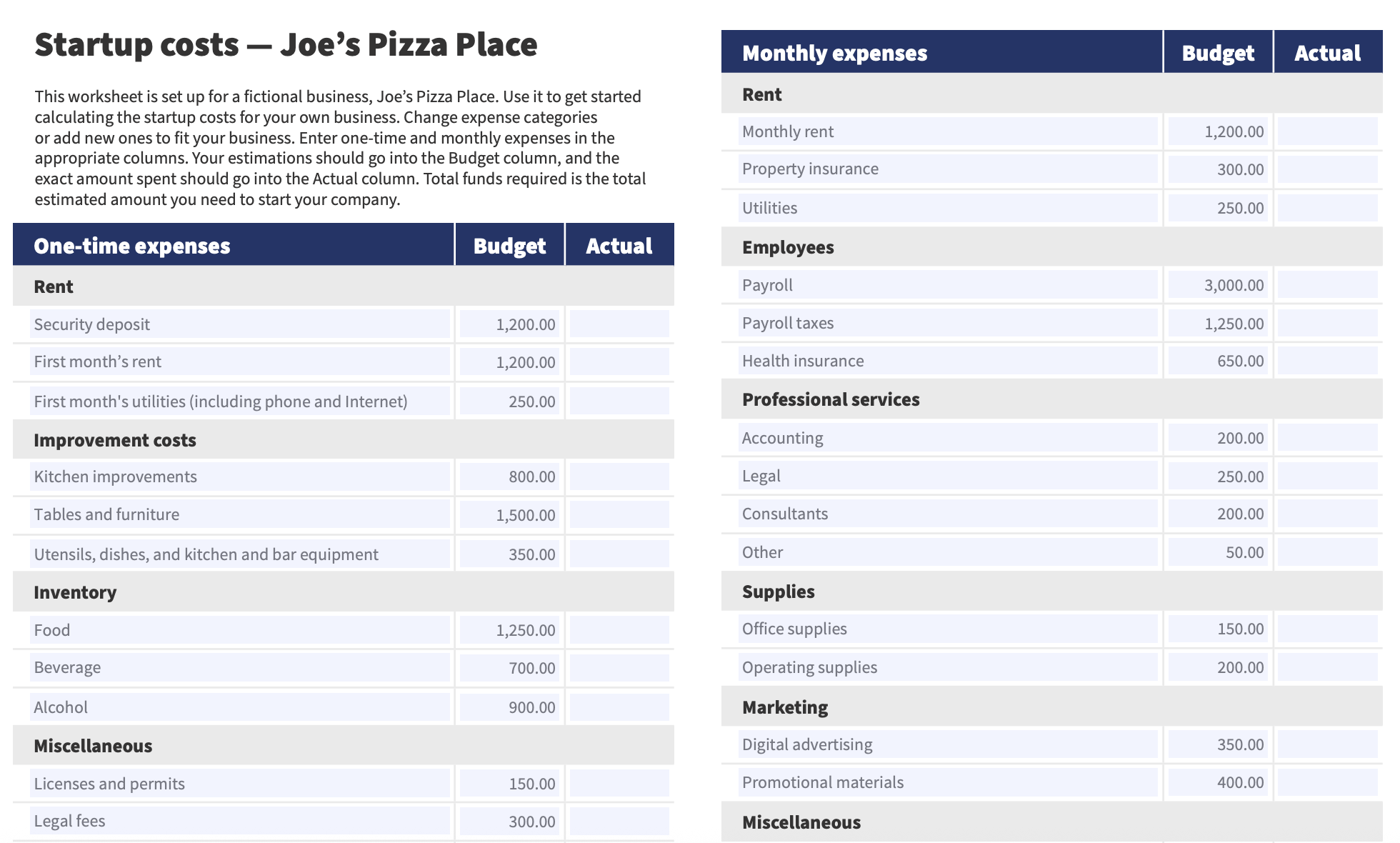
Take all of the pertinent expenses mentioned above and create estimates for each category. Remember: some expenses are clear-cut and fixed while others are one-time expenses that are more amorphous. Do your best to estimate costs based on current market conditions and research. Once you have your list complete, add up all of your projected numbers.
A step-by-step walkthrough
The SBA worksheet organizes your startup costs into categories (legal, location, equipment, marketing, etc.) and asks you to estimate one-time and monthly costs for each. Here’s how to use it effectively.
Step 1: Modify the worksheet to match your startup. The SBA worksheet is for a pizza kitchen, which has specific expenses (like a kitchen and many employees). Take the format and create your own spreadsheet, using the suggested expense categories in this article. Follow the SBA’s breakdown of one-time versus monthly expenses.
Step 2: List every expense category. Go line by line through your modified worksheet. For each category, enter your best estimate based on the research you’ve done (using the cost ranges in this article as a starting point). If you’re not sure about an exact amount, use the midpoint of a range.
Step 2: Separate one-time from monthly. The worksheet has columns for both. One-time costs (formation, equipment, first inventory order) go in one column. Monthly ongoing costs (payroll, hosting, insurance, software) go in the other.
Step 3: Calculate your Month 0 total. Add up all one-time costs plus your first month of ongoing costs. This is the cash you need on hand before you launch.
Step 4: Calculate monthly burn. Your monthly burn rate is your total ongoing expenses minus any recurring revenue. In Month 1, this is likely just your ongoing cost total (since revenue is usually $0 or close to it).
Step 5: Estimate your runway. Divide your available cash (after Month 0 costs) by your monthly burn. If you have $20,000 left after launch costs and your monthly burn is $2,000, you have roughly 10 months of runway.
Step 6: Revisit at 30, 60, and 90 days. Your initial estimates may be wrong. That’s expected — you won’t know how to estimate certain expenses until you start operating. At 30 days, compare actual expenses to your projections and adjust. At 60 days, look for patterns in variable costs. At 90 days, you should have a realistic monthly burn number you can use for longer-term planning.
Common pitfalls and forgotten costs
First-time founders frequently underestimate their startup costs because they’re simply unaware of the costs they will encounter. Here are the ones that catch people off guard most often.
- Sales tax permits: If you sell physical products (or taxable digital goods in certain states), you’ll need to register for a sales tax permit. The permit itself is usually free, but collecting and remitting sales tax adds operational complexity and may require software like TaxJar or Avalara ($19-$50+/month).
- Business insurance: General liability insurance is a baseline for most businesses ($30-$100/month). If you’re offering professional services, you may also need errors and omissions (E&O) coverage. Workers’ comp insurance is required in most states if you have employees.
- Payment processing fees: Stripe and Shopify Payments charge approximately 2.9% + $0.30 per transaction. At $10,000/month in revenue, that’s hundreds of dollars in processing fees alone. Many founders forget to include this in their monthly expense projections.
- Additional software seats: Free tiers of tools like Slack, Notion, and Figma are generous, but they often impose limits that force you to upgrade as your team grows. Budget for paid plans once your team exceeds 3-5 people.
- Shipping and fulfillment minimums: Many 3PL providers have monthly minimums ($200–$500/month) regardless of order volume. If you’re just starting out with low volume, these minimums can eat into margins quickly.
- Data and hosting overages: Cloud providers bill based on usage. A spike in traffic from a product launch or press mention can trigger unexpected charges. Set billing alerts early.
Annual state fees: Many founders budget for the initial LLC filing fee but forget about annual franchise taxes, annual report fees, or registered agent renewals. These vary by state (see the table above) and can add $200-$800+/year.
Getting a handle on the costs of launching and running your business isn’t just a smart move—it’s the key to laying down a solid foundation for your company. With a clear view of these expenses, you’re setting yourself up for steady growth and paving the way for long-term success.
Want to hear directly from a founder? Watch our video with Mango Puzzles co-founders Kemal Didić and Svet Lovoukhin on launching their business and navigating costs:
Glossary
These are terms you’ll encounter regularly as you launch your business and start operating.
Startup costs: Pre-launch expenses incurred while investigating or creating a business, deductible under IRC §195.
Organizational costs: Costs of legally forming a business entity, deductible under IRC §248.
Ordinary and necessary business expenses: Post-launch expenses that are common in your industry and required to operate. Fully deductible in the year incurred.
CAPEX (capital expenditure): Spending on assets with a useful life beyond one year (equipment, vehicles, improvements). Depreciated over time or expensed under Section 179.
OPEX (operating expenditure): Day-to-day expenses of running the business (rent, utilities, software subscriptions). Fully deductible in the year incurred.
Burn rate: The rate at which your company spends cash each month, calculated as total monthly expenses minus monthly revenue.
Runway: How many months your company can operate before running out of cash, calculated as available cash divided by monthly burn rate.
FAQs
What should I consider before calculating my startup costs?
Understanding your costs before launching helps you budget effectively, avoid surprises, set realistic milestones, and make sure you have enough runway until revenue starts coming in.
What's the difference between one-time and ongoing startup costs?
One-time costs are paid once at the start, such as incorporation fees or website design. Ongoing costs are recurring (payroll, payment processing, vendor payments) and are easier to predict and plan around.
How do fixed and variable costs differ for startups?
Fixed costs stay the same each month (like rent on a long-term lease). Variable costs can fluctuate based on business activity (utilities, shipping, cloud hosting, customer support as your user base grows).
What are essential versus optional startup expenses?
Essential costs are required to operate (payroll, rent, insurance, payment processing). Optional costs can enhance your business but aren't mission-critical (like social media scheduling tools).
What are the most common startup expenses to budget for?
Common startup expenses include incorporation fees, office space or virtual office subscriptions, payroll and processing costs, website development (domain, hosting, design), marketing, inventory for physical goods, and equipment like laptops or servers.
Are startup costs tax-deductible?
You can deduct up to $5,000 in startup costs and $5,000 in organizational costs in your first year. If your total exceeds $50,000, the deduction is reduced by the overage.
How do I calculate my total startup fees?
List every potential expense with an estimated cost, covering both one-time and ongoing costs. Add them up for your total projected startup fees.
What's the difference between startup costs and business expenses for tax purposes?
Startup costs relate to creating, launching, or acquiring a business (such as advertising or incorporation). Business expenses are ongoing operational costs (such as payroll, taxes, and insurance). The IRS treats them differently for deductions.
Related reads

The solopreneur’s guide to getting your first users

The hidden work behind every “overnight” AI startup

How to find investors for your small business